A Late-Summer Walk for Finding Seed Heads
A late-summer walk for finding seed heads helps you recognize changing flowers, follow their development, and decide which stems merit another look.
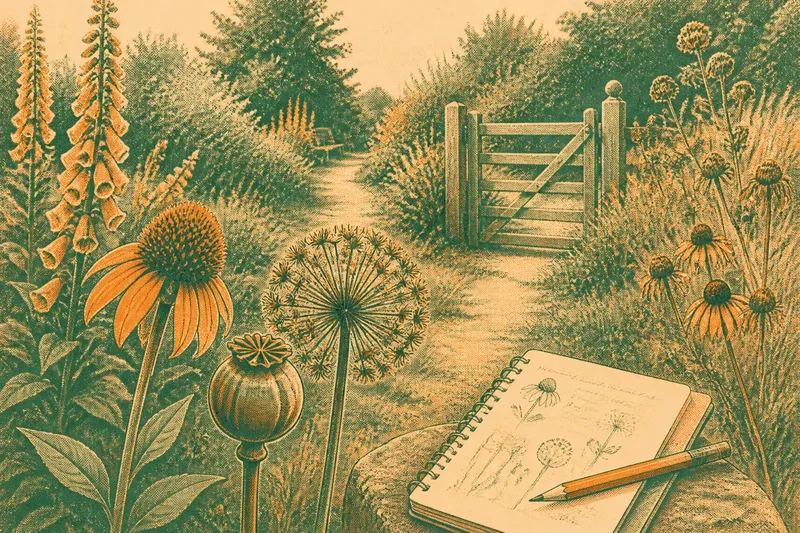
At the back gate, a coneflower still holds two curled petals around its dark center. Farther along the path, a poppy capsule has opened at the top. A late-summer walk for finding seed heads follows these changes in order, from fading blooms to formed capsules, so you can tell what is developing and what has already begun to release seed.
Bring a pocket notebook and pencil; a phone can record the plant and its location if you want to return to the same stem. Begin at one end of the garden and move along a familiar path. Pause at each candidate, note its stage, and continue rather than deciding immediately what to cut or collect.
Start with fading blooms
Look first for a flower that still has some color. Notice whether the petals are folding, loosening, or falling while the center remains attached. On a black-eyed Susan, for example, curled yellow rays can make the dark central disk easier to see. That is an early transition, not necessarily a mature seed head.
Check the center’s shape and firmness without pulling it apart. Is it flat, rounded, or pointed? Are its small parts still closely packed, or are gaps appearing? A developing head may retain petals or look dry before its seeds are ready. Record what you see, then leave the stem in place for a later comparison if you are unsure.
Follow the path
Make the walk a sequence of observations. At the first stop, note flowers with petals still attached. At the next, look for heads whose centers are distinct and whose petals have mostly fallen. Near the end, look for capsules or heads that have opened or started to shed material. These stages will not appear in a neat order in every garden; the point is to compare what is present, not to force each plant into a timetable.
Say you begin beside a path with a coneflower whose petals are curling and whose raised center is still firm. In your notebook, write “gate-side coneflower: petals attached, center closed,” and note the dry grass behind it. On a later walk, suppose the petals have fallen and small gaps show in the center. Add that observation beside the first one. The resulting comparison tells you the head has changed from a fading bloom to a more open structure; it does not establish that every seed is ripe.
As you move, keep an eye out for forms that are easy to miss: upright foxglove spikes, rounded allium heads, and poppy capsules. A label can help identify a plant, but do not collect seed from a flower you cannot confidently identify. If you intend to save seed and are uncertain about identification or local suitability, ask a local horticultural professional or extension service.
Record useful clues
A few specific notes make a return visit more useful than a long list of plant names. For each stem you choose to follow, check these details and let the observation guide your next action:
- Petals remain attached: if the center is still enclosed, record it as a fading bloom and revisit later; if the center is exposed, note the change and continue watching.
- The center feels firm and keeps its outline: if it is intact, leave it for comparison; if it is collapsing, record the damage and look for a healthier head nearby.
- The head is opening or shedding material: if seeds are dispersing and you want to save some, consult the plant label and local guidance before collecting; if not, leave the head undisturbed or remove it according to your garden plans.
- The stem leans into a path: if it obstructs passage, support or trim it as appropriate for the plant; if it does not interfere, leave it standing for another observation.
- The head is hard to distinguish against its background: if a small change in viewing position reveals its outline, note that spot; if it remains obscured, choose a clearer stem to follow.
- The plant has no label and is unfamiliar: if you cannot identify it reliably, do not collect its seed; if you can confirm its identity, check local guidance before deciding whether to save it.
Questions along the way?
Why is there no clear seed head?
Some flowers shed their small structures quickly, and others make subtle heads that are difficult to see. The bloom may also have been deadheaded, leaving little to follow.
Why does a head look ragged?
Wind, rain, browsing, or natural seed release can loosen its shape. Note whether the stem is still upright or is interfering with a path, then decide whether to leave it, support it, or trim it.
Can color tell me if seeds are ripe?
Color alone is not a dependable cue: some heads darken early, while others stay green as seeds develop. Check the plant label and seek reliable local guidance before collecting seed if you are unsure.
What if I cannot identify the plant?
Leave its seed head intact until you can confirm what it is. A local extension service or horticultural professional can help with identification and advice relevant to your area.
Choose what stays
At the end of the path, consider each stem’s practical place in the garden. A standing head may add late-season interest or offer seed for wildlife; a broken stem across a walkway may be better supported or removed. If you are managing a plant that could spread or have concerns about its suitability, check local guidance before leaving seed to mature.
It is not worth mapping every head or recording every change. That can turn a quiet walk into paperwork. Choose a few identifiable stems and make notes brief enough that you will actually use them on a return visit.
Return to one stem
Pick a landmark—a gate, bench, or path corner—and use it to find the same plant again. Look for a change in the petals, the center’s openness, or the stem’s position. A second visit can clarify whether a head is still forming, opening, or already shedding, while reminding you that neighboring flowers may be at different stages.
For a late-summer walk for finding seed heads, the most useful record is often just a plant name, a visible clue, and a place to find it again. That small note can help you decide whether to wait, collect with proper identification and local guidance, or clear a stem that has become an obstacle.