Why Some Flowers Have a Landing Strip
Flower landing strips pair petal markings with bloom shape. Learn to read these visual routes and see how they may guide a pollinator toward the center.
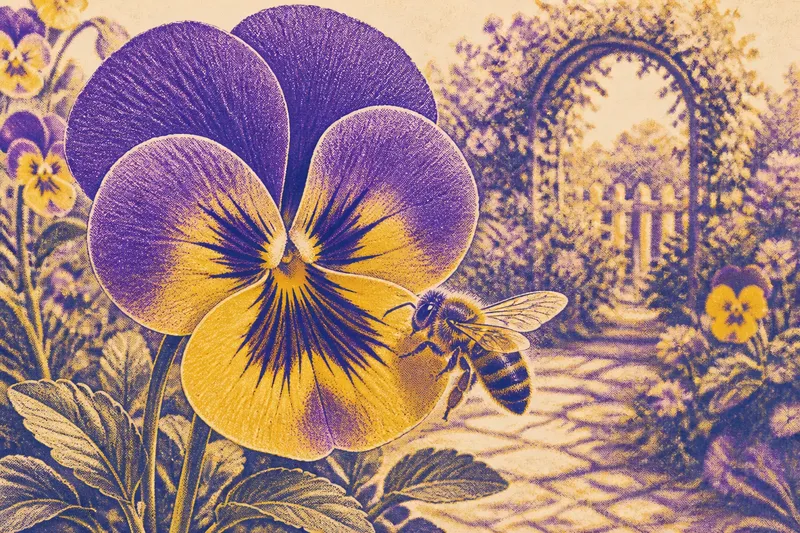
A bee hovers beside a purple pansy, then settles on its lower petal. Dark strokes on the bloom point inward, toward the center. These apparent flower landing strips pair markings with shape to offer a route into the flower, though different visitors may respond to different cues.
Landing strip patterns
“Landing strip” is a handy name for markings or petal shapes that seem to lead toward a flower’s center. The marks might be lines, spots, or a patch of contrasting color; the shape might be a broad petal that offers a place to land. It is not a literal track, nor does every flower have one.
The center may contain nectar, pollen, or both, alongside the reproductive structures. Stamens bear pollen, and the stigma receives it. A visitor moving through this area may contact those parts. Petal form and pattern can therefore affect how a visitor approaches, as well as what it sees.
A visual cue is not a command. Scent, light, flower position, surrounding blooms, and a visitor’s own behavior can also shape an approach. It is more careful to say that markings and form may help some pollinators orient toward a flower’s center.
Color and shape
Start with contrast. On a pansy, dark markings on the lower petals can appear as strokes radiating toward the center. They stand out from the surrounding color and give the eye a path to follow.
Then notice the flower’s geometry. A lower petal may be broad or angled, while the petals around an opening may frame it. A tubular bloom presents another kind of route: its opening leads inward, and a lip or side petal may offer a place to alight before entry.
These features need not work alone. A patch of color can make the center conspicuous, while petal shape frames an opening. Together, they create a visual and physical arrangement that a visitor may use as it approaches.
Patterns beyond sight
Human eyes do not reveal every pattern a flower may present. Some pollinators perceive ultraviolet wavelengths, so a bloom that looks evenly colored to us may have contrasts for them that we cannot see unaided.
Even without seeing those patterns, you can observe veins, changes in texture, a bright center, or petals that frame an opening. These visible features describe the flower from a human viewpoint; they do not tell the whole story of how it appears to another animal.
Not every dark mark is necessarily a directional cue. Pigment can have different roles in different flowers. A modest reading is best: when a mark lies along a route toward the opening, it may help some visitors perceive that route, especially in combination with the bloom’s shape.
Reading the route
Imagine a bee approaching a flower with a broad lower petal and a narrow opening above it. Contrasting lines on the petal point toward the opening, and the side petals frame it. The bee might land on the broad surface and move inward; an observer could watch whether its path follows the marks or takes another route.
This invented scene illustrates a possibility, not a fixed response. A visitor may hover, approach from a different direction, or disregard the pattern. The flower’s form can make one route easier to see or enter without determining what the visitor will do.
After landing, a visitor may brush against anthers or the stigma as it reaches inward. In some flowers, the arrangement of petals and reproductive structures brings those parts near the route into the bloom. The relationship between the landing surface and the center is worth noticing, but it varies from flower to flower.
Flower landing strips?
Do all flowers have landing strips?
No. Many flowers lack obvious markings or a distinct landing surface. Visitors may respond to other cues, such as scent, color, shape, or where the bloom is growing.
Are the markings always for bees?
No. A pattern may be more noticeable to some visitors than others, and pollinators can respond to different combinations of shape, scent, timing, and color. Bees are one familiar example, not the only possible visitor.
Can I see ultraviolet patterns?
Not with ordinary human vision. You can examine visible markings in natural light, but that view does not reveal how a flower looks to an animal that detects ultraviolet wavelengths.
Does a landing strip ensure a visit?
No. A visible cue does not ensure that a pollinator will notice or choose a flower. Other blooms, scent, light, and the visitor’s needs may also influence its behavior.
Garden observations
Look at a bloom from the side a visitor might approach. Note whether its markings converge toward the center, whether a petal offers a perch, and whether the opening faces up, sideways, or down. Then compare flowers of the same kind: the pattern may be similar even when orientation or wear differs.
A hand lens can bring veins and surface texture into view, but it is not essential. A quick sketch of the strongest markings and the way the petals frame the center is enough to keep your attention on observable details.
- Markings: If lines or spots converge on the opening, follow them toward the center; if they do not, describe their position without calling them a route.
- Landing surface: If one petal is broad or angled beneath the opening, note its position; if no petal stands out, focus on the shape of the opening instead.
- Flower opening: If petals frame a clear entrance, trace its direction; if the center is exposed, note which parts surround it.
- Visible contrast: If a mark stands out in natural light, record its color and location; if it blends in, do not infer that another viewer sees the same pattern.
- Visitor approach: If a visitor follows the apparent route, note where it lands and moves; if it takes another path, record that observation rather than treating the cue as a rule.
- Repeated blooms: If several flowers share the same arrangement, compare how their orientation differs; if they vary, describe each bloom on its own.
It is not worth assigning a precise intention to every stripe or spot. A flower is not a coded map with one universal translation. The more useful question is how a visible mark relates to the opening and to the parts a visitor might touch.
Pattern meets form
Flower landing strips are best understood as one part of a larger arrangement. Contrast may draw attention inward, petal shape may offer a place to land, and the center’s structure may shape where contact occurs. These features can make an approach more apparent without dictating a visitor’s behavior.
When a marked bloom catches your eye, follow its lines toward the center and notice how the petals frame that route. The useful detail is whether the apparent path ends at the opening or continues past the flower parts a visitor may encounter there.